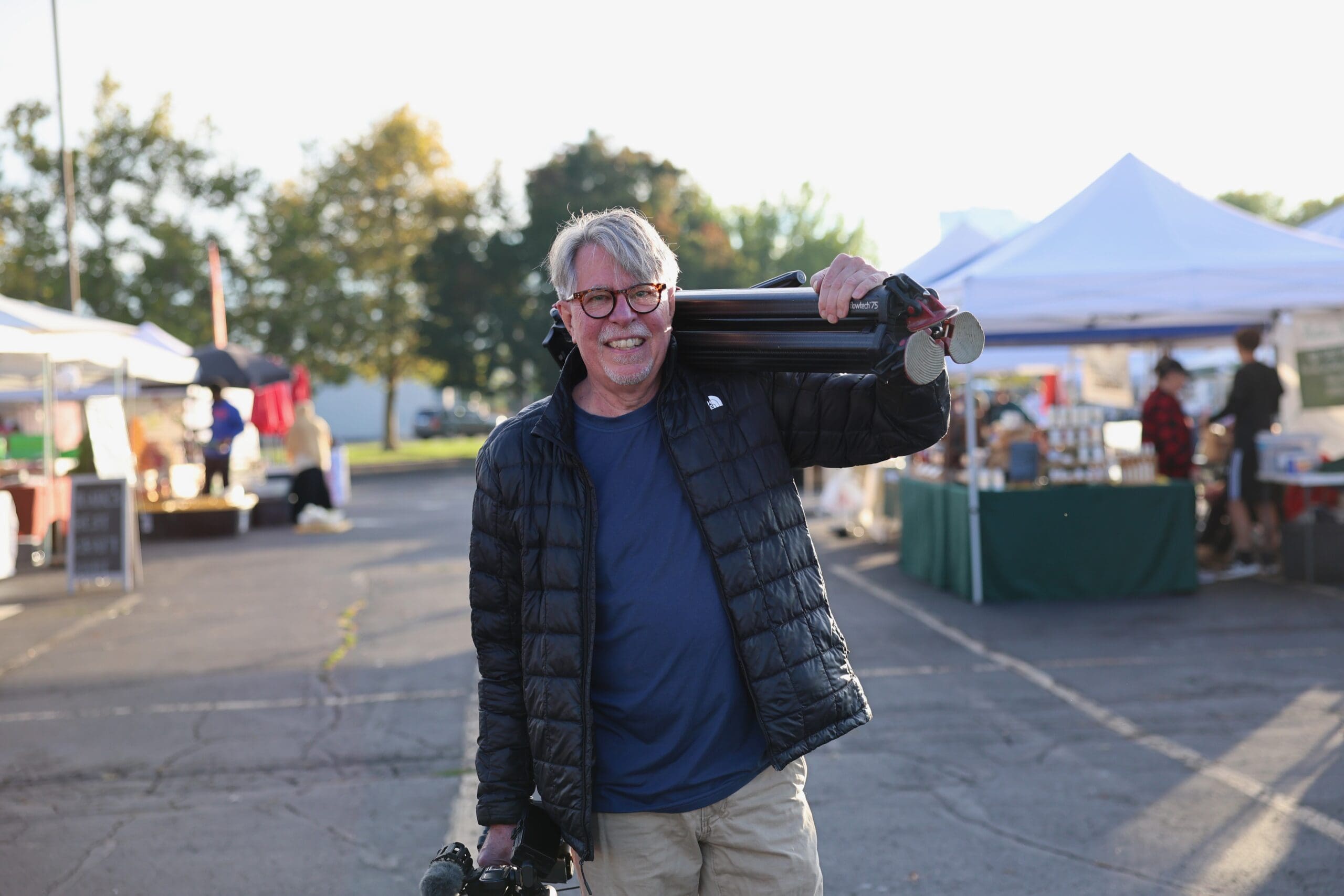
For photographer and videographer Guy Hand, food has never been just about what’s on the plate. He’s interested in the people, places, history and traditions behind it. He appreciates the stories that explain not only what we eat, but where it comes from and why it matters.
That perspective has made Hand one of the most recognizable visual storytellers in Idaho’s food community. Even if you don’t know his name, you have seen his work. His photographs and videos have documented the evolution of Boise’s culinary scene, from the growers and producers at the Boise Farmers Market to Idaho farms and ranches. For more than a decade, he has also documented the tasting menus of KIN, creating an ongoing visual record of one of Boise’s most notable restaurants. It’s an unlikely path for someone who once had little interest in food photography.
Hand was born in Twin Falls and moved to Boise in the fifth grade. He is a third-generation Idahoan, with a family history rooted in agriculture. His grandfather came to Idaho from Illinois in the early 1900s, reportedly riding in a cattle car with his livestock to Ridgefield. Hand’s family lore is filled with farmers and ranchers.
Food itself was another early influence. “I’ve always loved food,” Hand says. “Ever since I was a little kid, I cooked and I was always fascinated with it.”
He started reading cookbooks when he was about 10. “I had this sense that good food was something to seek out and pay attention to,” Hand recalls. In high school, he would occasionally take himself out to dinner at Churchill’s, a French restaurant, where quiche Lorraine and French onion soup seemed exotic. In college, he became the person who cooked for the house.
At Boise State, Hand initially studied psychology. After three and a half years, he realized this was a field he no longer wanted to pursue. He applied and was accepted to the prestigious Brooks Institute, a visual arts college in Santa Barbara, where he began taking photography classes.
Photography appealed to him for a simple reason: It offered an escape from the conventional workplace. “I didn’t want a 9 to 5 job,” he says. “I didn’t want an office job. I wanted to be outside.”
Brooks was a revelation. The school attracted students from around the world, and the young man from Idaho suddenly had friends from around the world. He found himself immersed in a new culture in Santa Barbara that felt almost like a Mediterranean village. He discovered that he loved photography, but he also quickly learned he preferred being on location to working in the studio.
After graduating, Hand moved to New York City, following many of his classmates. He found work the day after he arrived as a freelance assistant, working for some of the city’s leading photographers. Among his assignments was assisting on elaborate food shoots for major magazines such as Bon Appétit.
The shoots were technically impressive, but Hand found them tedious. A single photograph could take an entire day, with huge cameras, elaborate lighting, food stylists and hand models. “I hated it,” he says. “I thought it was so boring.”
Instead, he gravitated toward travel photography. Before long, he was known as the “travel guy,” scouting locations, producing shoots and eventually orchestrating entire productions. His assignments took him around the world, photographing subjects from cars to cigarettes to liquor, the three most lucrative industries for advertising at the time.
Food wasn’t his job, but it remained a fascination. The work gave him the opportunity to eat in some of the world’s great restaurants, from Hong Kong to Sydney. He experienced the kind of food and hospitality that most people only encounter occasionally, and it deepened an interest that had been there since childhood.
After 25 years in the industry, Hand began to feel burned out by advertising. He and his wife were living in Santa Barbara, where buying a home seemed increasingly out of reach. He had started writing and doing public radio, moving toward editorial work and journalism.
Then, almost by accident, Idaho called him home. Hand was in Boise on his way to catch a flight after a radio assignment in North Idaho when he spotted a house for sale. He and his wife went to look at it and discovered that buying the house would cost less than they were paying in rent in Santa Barbara. They moved back.
“I always thought I’d have a connection to Idaho,” Hand says. “But when my parents died, I realized, I don’t have that connection anymore. I always loved the mountains and the outdoors here.”
Freelance work meant he could live wherever he wanted. And once he returned, he began reconnecting with the local food community. The Boise Farmers Market became an early entry point. Hand started talking with growers and producers, initially without even taking photographs. He was drawn to the people and their stories. That interest eventually developed into writing, radio, photography and, ultimately, video.
He created a public radio show about food for Boise State Public Radio called Edible Idaho, which ran for eight years. He also wrote restaurant reviews for the Idaho Statesman and other publications and helped launch Edible Idaho magazine, which ran for eight years before the pandemic brought it to an end.
Along the way, Hand began traveling around Idaho on his own dime, photographing farms he found interesting and making short videos about them. “I’d just go someplace and hang out,” he says.
That phrase captures something fundamental about Hand’s approach to storytelling. He doesn’t seem particularly interested in parachuting into a place, getting the obligatory photographs and leaving. He wants to spend time with people. He wants to see how they work, understand what they care about and discover the details that make their stories distinctive.
It’s also what eventually drew him toward video. At Brooks, Hand had chosen still photography over film because he wanted to work independently rather than with a film crew. But years later, he began to see the limitations of still images.
“A photograph is worth a thousand words,” he says, “but it’s really worth a thousand words of visual description.”
Video offered something different. It combined images, sound, movement and conversation. After working in radio, he had also discovered the power of audio storytelling. Film brought those two worlds together.
“With video I can really tell a story,” he says.
Hand taught himself how to shoot and edit video, gradually building his equipment and his skills. One of his earliest projects came when Peaceful Belly asked him to make a Kickstarter video. At the time, he didn’t even own a camera capable of shooting video and had to borrow one. He was hooked.
As his video work evolved, so did his focus. Food and agriculture became natural subjects because they combined his visual background with his fascination with the larger stories behind what we eat.
He had long been intrigued by those stories; the origins of ingredients, the history of foods, the trade routes and cultural connections that explain how something ends up on a plate.
“I love the story behind it,” he says.
That philosophy is evident in his long-running relationship with KIN.
Hand first encountered the restaurant’s founders when they were operating State & Lemp. Around 2013, while working on Edible Idaho, he heard about the unusual concept: an expensive prix fixe tasting menu served around a communal table.
“I went and thought, that’s gonna last, like, a month, maybe,” he says.
Instead, it became one of the defining restaurants of Boise’s contemporary food scene. Hand photographed and interviewed the team for Edible Idaho and soon began documenting the restaurant’s menus. More than a decade later, he continues to photograph KIN’s tasting menus, having missed only a handful along the way.
There is an irony to it. The photographer who once couldn’t stand studio food photography now spends considerable time carefully documenting dishes. But there’s an important difference.
At KIN, the food is part of a larger story. Each menu is a progression, shaped by season, ingredients, technique and the vision of the chefs. Hand isn’t simply photographing attractive plates. Over years of documenting the restaurant, he has created an evolving visual archive of its work.
His freelance work encompasses a wide range of food and beverage related clients including The Avery, Alavita, Bittercreek Ale House, Telaya Wines, Savor Idaho, Idaho Preferred, and the Boise Farmers Market. Other clients include The University of Idaho, Idaho Botanical Garden, Friends of Minidoka, and the Sun Valley Institute.
After all these years, Hand considers himself fortunate to have built exactly the kind of career he imagined when he left Boise for photography school.
“I realized that I’ve never had a real job,” he says. “And I feel so grateful.”
Decades later, that instinct has taken him from New York studios to farms across Idaho, from public radio to restaurant kitchens, and from still photography to video.
But perhaps the common thread is simpler than that. Hand likes to get close to people and their work. He likes to follow the trail behind a finished product and discover the human stories along the way.
“As a journalist, I just love to kind of insinuate myself into somebody else’s life,” he says. “There’s nothing I like better.”
For a photographer whose work has become so closely associated with food, that may be the most important thing to understand about his pictures. The food is often the entry point.
The real subject is the story.
Thanks for reading!
With love from Boise,
Marissa
This story was written by Dave Yasuda. Dave is a writer, eater, cyclist, and director of Foodfort at Treefort Music Fest. His writing has appeared in Bicycling, Wired, and the New York Time’s The Wirecutter. View his food thoughts on Instagram: @highzoot
If you’re interested in getting your product, service, or event in front of 25k Boise locals → book a call