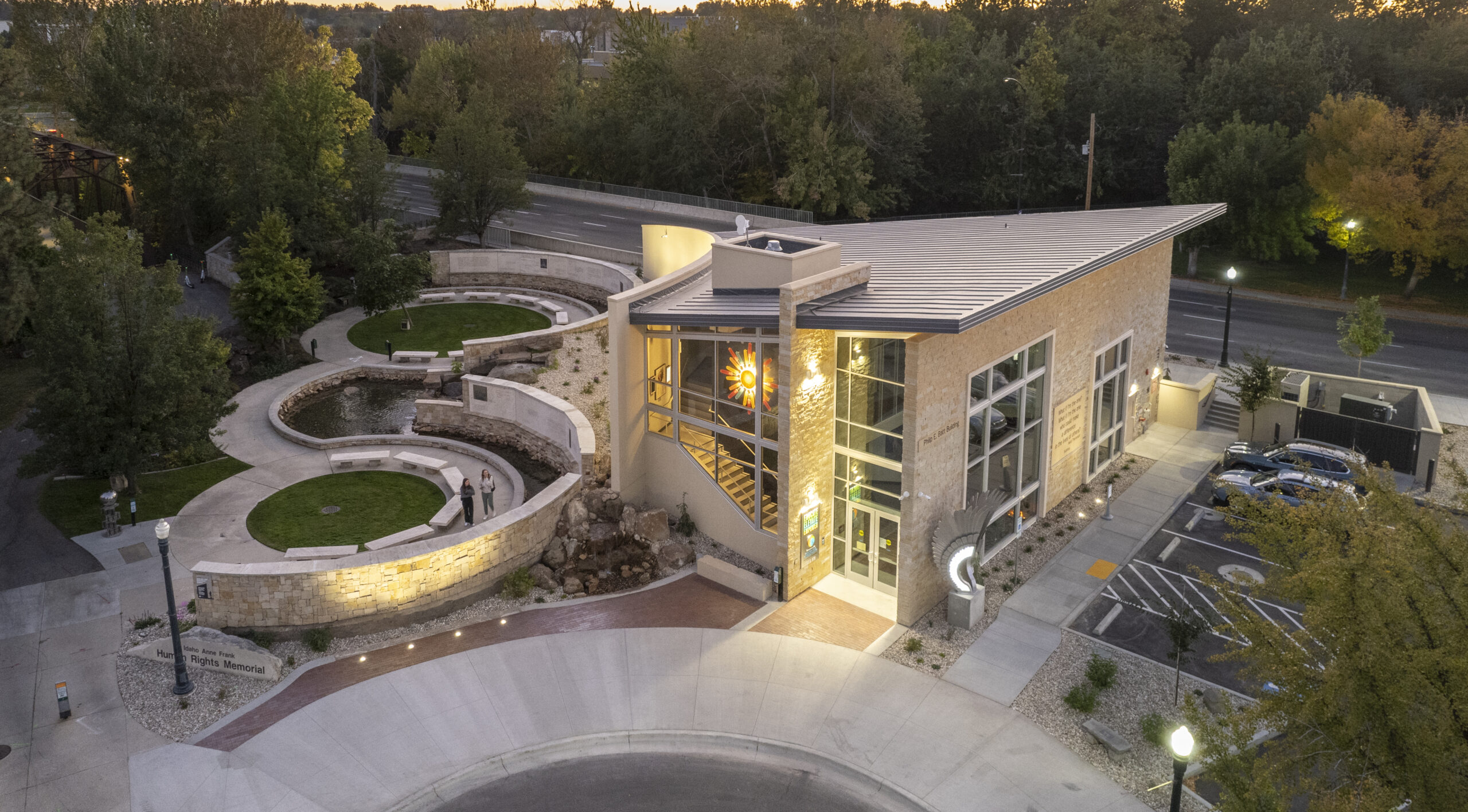
You’ve probably walked or biked by it on the Greenbelt, or driven past it on your way up 9th Street from downtown. There’s a beautiful building sitting right next to the Idaho Anne Frank Human Rights Memorial. It’s a peaceful little corner of downtown Boise, tucked between the Boise River, the library, and Capitol Boulevard.
That little corner is home to the Wassmuth Center for Human Rights. This year, the organization is celebrating 30 years.
The Wassmuth Center is a nonprofit human rights education organization. It was founded in 1996 to build the Idaho Anne Frank Human Rights Memorial, which opened to the public in 2002. Two years ago, the Center finished construction on the Philip E. Batt Education Building, and now the Memorial and the building together make up what they call “the campus.” It’s completely free to explore, and more than 120,000 people visited the Memorial last year alone.
I got a tour from Christina Bruce-Bennion, the Wassmuth Center’s executive director. I’ve lived here for over 15 years and I’ve been to the Memorial dozens of times, but there are so many things I’d missed until she pointed them out.
“The building has been just a wonderful complement to the Memorial,” said Christina. “We’re able to do a lot of the programs consistently that we really couldn’t have when it was just an outdoor space.”
How it started
To understand the Wassmuth Center, you have to go back to the 1980s and ’90s in Idaho.
Bill Wassmuth grew up in Greencreek, a small town in northern Idaho, and became a Catholic priest in Coeur d’Alene. At the time, the neo-Nazi group Aryan Nations had built a compound near Hayden Lake. As the group got louder and more aggressive, Bill helped form a local coalition of people from different faiths and political backgrounds to push back. Even after his home was bombed, he kept going. Eventually, a lawsuit bankrupted Aryan Nations and shut the compound down.
“He was so good at inspiring others to use their voices,” said Christina. “And they got really creative in the ways that they countered that work.”
Meanwhile, Boise was dealing with its own share of tension. In 1994, a group called the Idaho Citizens Alliance got a measure on the statewide ballot called Proposition 1. It would have kept gay people from being granted minority status, refused to recognize same-sex marriages and domestic partnerships, prevented teachers from talking about being gay as acceptable, banned state money from being spent on anything that seemed to accept or approve of gay people, and limited library books on the subject to adults only. Idaho voters rejected it by just over 3,000 votes.
Then in 1995, a traveling exhibit called Anne Frank in the World came to the Idaho State Museum, and more than 45,000 people went to see it. Boise was a much smaller city back then, so that was a big deal.
A group of local women took notice. They didn’t want Idaho to be known as a hateful place, and they saw how much Anne Frank’s story was connecting with people. Their first idea was to put a stone or flower garden along the Greenbelt. As they talked to more people, the idea grew into a full human rights memorial.
Christina says two things about Anne’s story really resonated.
“Even though she was in these terrible circumstances, she was also very much just a normal teenager, and she didn’t lose her faith in humanity,” said Christina. “And the other part of the story is that when we see oppression start to happen against one group, we know it never stops there.”
The Memorial was a community effort from the start. Schoolkids all over Idaho collected their spare change to pay for the bronze statue of Anne Frank.
“It has, from the very beginning, literally brick by brick, bench by bench, penny by penny, been a community process and space,” said Christina.
Exploring the Memorial
The Idaho Anne Frank Human Rights Memorial is the only memorial of its kind in the United States. It’s open every day from dawn to dusk, and it’s always free.
The first area you’ll walk into are the quote circles, with more than 60 quotes from people across history and around the world. Even with 9th Street right there, it’s a quiet, reflective spot. Christina says almost any time she walks out here, someone is eating lunch, showing visitors around, or letting their kids run around.
Then there’s the statue of Anne herself, looking out an open window.
The tall, narrow structures around the statue, along the Greenbelt, were designed to look like the Amsterdam skyline. I’ve biked past this a thousand times and never noticed that detail. There’s also a nod to the bookcase that hid the entrance to the annex, and the steps leading up into the Memorial from the Greenbelt entrance match the number and narrowness of the stairs in the house in Amsterdam. There are lines carved into the ground behind Anne’s statue showing the actual size of the annex, where eight people hid for two years.
Across from the statue, there are six large stone tablets with the full text of the Universal Declaration of Human Rights. It was adopted in 1948 after World War II. This is one of the few places in the world where you can read the entire thing on public display.
Christina explained the difference between civil rights, which are granted and protected by the government, and human rights, which every person is born with.
“It’s an interesting thing to spend time with that language,” she said. “It’s sort of like, how are we doing?”
You’ll also find a sculpture called The Other, designed and fabricated by artist Ken McCall, which represents a framework the Center uses called the Spiral of Injustice. It shows how injustice can build from language to discrimination to violence, and how people can step in and interrupt it along the way.
Inside the Philip E. Batt Education Building
The building opened in 2024. It’s 6,355 square feet and full of natural light.
Inside there are 30 works of art by 26 Idaho artists and students, all centered on human rights themes. Many have QR codes that pull up a short video of the artist talking about their piece. There’s Hope’s Defiance, a smalti mosaic by Reham Aarti, which shows a woman standing on a stack of books, pushing back against the darkness with cracks of light breaking through. Along the stairs is Popsicle Sun, a 6-foot-wide illuminated public art installation by Stephanie Inman, inspired by a young local boy who had a giving spirit.
One of my favorite things was a display one of their volunteers made. It’s a shelf of books that have been banned or challenged in Idaho school districts, and each book sits behind a tiny 3D-printed jail cell door. I had no idea Harry Potter was included in this list.
Upstairs is the classroom, which Christina says gets reconfigured about a hundred times a week depending on who’s using it. Some days it’s preschoolers with a big circle rug and art supplies. Other nights it’s a speaker or a community event. Community groups can rent the space, too.
Then there’s Dimensions in Testimony.
It’s an interactive exhibit created by the USC Shoah Foundation (founded by Director Steven Spielberg), set up in a small room in the back corner of the building. When you walk in, you’re facing a floor-to-ceiling screen next to a large bookcase. You choose who you want to talk to, ask a question out loud, and they answer you.
And it’s not just questions about the Holocaust. They’ll tell you about their childhood, their families, what they went through and what they saw, and how they rebuilt their lives after liberation. The answers are pulled from hundreds of hours of real filmed interviews, and none of it is generated by AI.
There are five people you can talk to:
- Eva Schloss survived Auschwitz and went on to become a renowned author and speaker.
- Aaron Elster spent two years as a child hiding in a neighbor’s attic.
- Pinchas Gutter was the first participant to help bring this technology to life.
- Anita Lasker-Wallfisch survived by playing cello in the Women’s Orchestra of Auschwitz.
- Alan Moskin was a teenage soldier in the U.S. Army who helped liberate the Gunskirchen concentration camp.
Every session is facilitated by trained staff or volunteers. As you can imagine, it’s a moving and sometimes difficult experience, so they’re intentional about where the conversation starts.
“We start with something like, what was your childhood like, or tell us about your family, or what was your favorite hobby,” said Christina. “It’s really important to humanize them. You can even ask them questions like, do you believe in forgiveness?”
Dimensions in Testimony is recommended for 8th grade and up. It’s open to the public on Fridays from 12–4pm, with sessions starting every hour. For a private appointment outside those hours, email info@wassmuthcenter.org.
Programs for everyone
The Wassmuth Center offers more than 20 programs and over 90% of them are free. Some happen on campus, others are in classrooms or offices around the state, and some are offered online.
There are speakers, conversations, and book clubs for adults. There are leadership programs for teens, and fellowships and workshops for educators and business professionals. And every Tuesday morning from 10–11am, September through May, there’s Compassion Crew for kids ages 3–5 and their caregivers. It’s free and no registration is required.
Field trips come to the Center from all over the state, from Mountain Home to McCall to Eastern Idaho and even Oregon. Each one is designed for the kids’ age, so a third-grade class has a different experience than a group of high schoolers. Christina says adults tell her all the time that a field trip here in seventh-grade changed how they thought about something.
Christina often thinks about something Eleanor Roosevelt said, that human rights start in small places close to home.
“Often we think of the big thing that’s out there,” said Christina. “But the change and where we have the ability to impact is actually often much closer to home. And it’s in lots of small ways that sometimes don’t feel big enough, but that ripple effect still matters.”
Go visit
The Idaho Anne Frank Human Rights Memorial is at 770 S 8th St, and it’s open every day from dawn to dusk. The Philip E. Batt Education Building is right next door at 777 S 8th St. It’s open Monday through Friday from 9am to 5pm, closed Mondays from 1–3pm. Both are free.
A great time to visit is during their Drop-in Discovery Hours every Friday from 12–4pm. Docents are there to show you around and Dimensions in Testimony is open to try.
“I would invite anyone who’s new to the area,” said Christina. “It’s right here in downtown Boise and there’s so many really wonderful things around us. It’s worth a trip. Join us for a program or just come walk through the Memorial.”
You can find all their programs and upcoming events at wassmuthcenter.org. To stay in the loop, sign up for their weekly newsletter, the Dignity Dispatch.
Thanks for reading!
With love from Boise,
Marissa
This story is sponsored by the Wassmuth Center for Human Rights.
If you’re interested in getting your product, service, or event in front of 25k Boise locals → book a call